
The debate over whether to use AI in higher education is over. The real question now is which use cases are worth pursuing, and where to start. These six are already running inside real enrollment, student success, and finance offices, producing results that can be measured.
Six use cases already in production
1. Transcript processing and transfer credit evaluation
An agent extracts course data, recalculates the GPA, and maps courses to equivalencies, cutting a two-to-three-week manual review down to minutes. Staff still review and approve; they just start from work that's already done. Because evaluations return in hours instead of weeks, financial aid timelines compress and advising conversations happen earlier.
2. Document verification at upload
Every transcript, test score, and ID gets checked for authenticity the moment it's submitted, instead of sitting in a backlog reviewed one file at a time. Anything that fails gets flagged for staff, with the specific issue attached. Staff attention shifts from data entry to exception handling: the cases where something is genuinely off.
3. Fraud detection in submitted documents
The agent looks for the same signals a trained analyst would: formatting anomalies, internal inconsistencies, and patterns repeated across unrelated documents. It never rejects automatically; it flags for human review with the anomaly identified. Detection that used to be catch-as-catch-can becomes systematic, since the agent never misses a flag because the queue is full or a deadline is close.
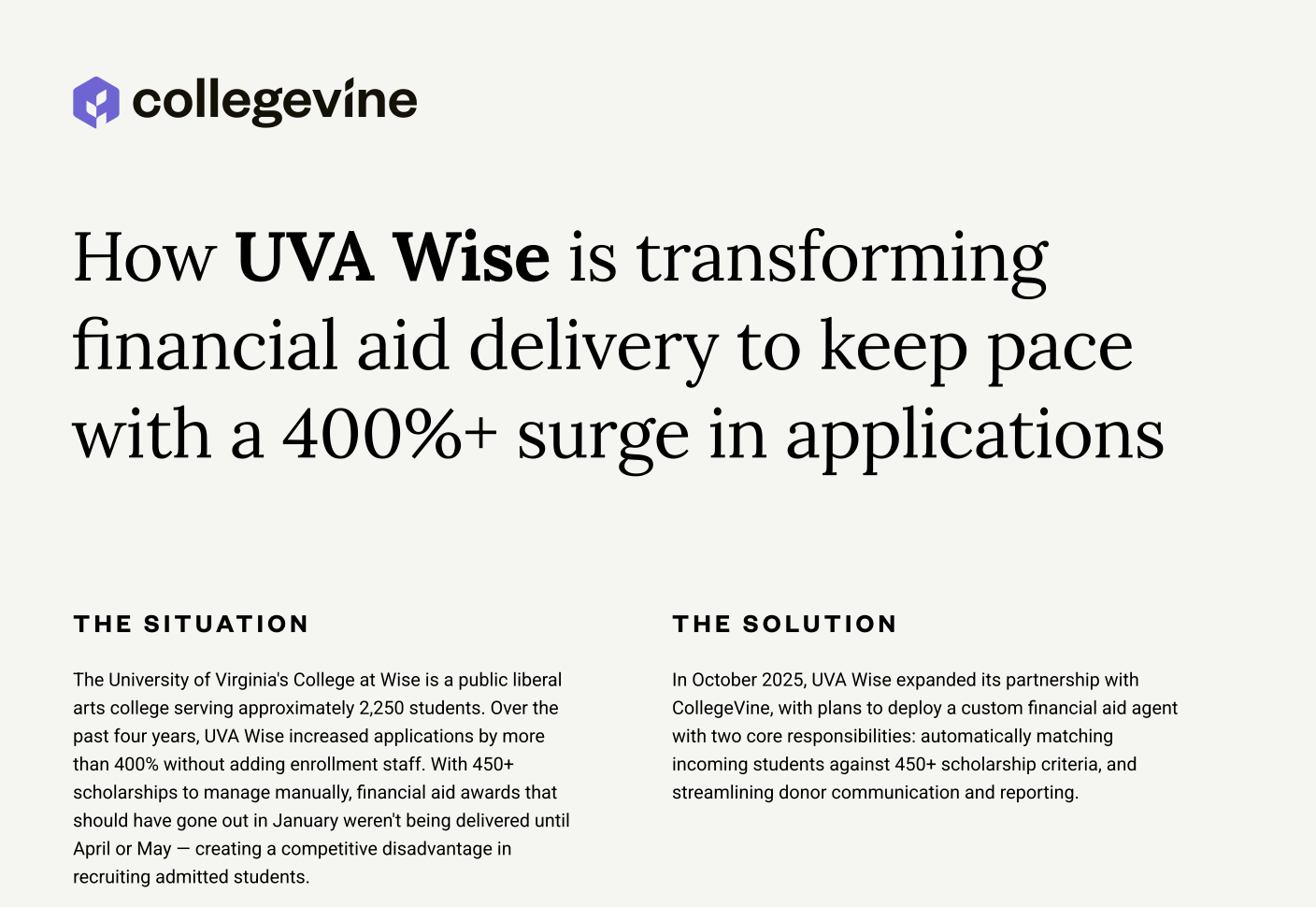
4. Scholarship matching and award recommendations
What used to take financial aid staff hours of manual eligibility review now takes an agent seconds, with the reasoning behind each match included. Staff stay responsible for approving awards and handling exceptions. Students learn what they're eligible for sooner, at one of the highest-stakes moments in the enrollment process.
5. Student-worker scheduling
One institution cut scheduling time from 36 hours per supervisor per year to under two, returning roughly 1,360 hours annually across a 40-supervisor team. The agent builds a complete proposed schedule directly from each student's class calendar and the institution's labor rules, accounting for conflicts and coverage gaps automatically. Supervisors spend the time they get back mentoring students instead of building shift calendars.
6. Natural-language data querying
Leaders ask for enrollment or financial data in plain language instead of routing a request up the chain, cutting a two-to-three-day, 20-plus-staff-hour turnaround down to minutes. The agent queries the connected systems and returns the answer, sometimes as a dashboard built on the fly. The same capability extends to scheduled reporting, so a leader can get a deposit summary every Monday morning without anyone producing it by hand.
Read the full report for a deeper breakdown of each use case and a framework for deciding which one to build next.










.png)
.png)


.png)