
The question many colleges and universities are asking about artificial intelligence (AI) is, "Which tool should we buy?" That is the wrong question.
A new category is arriving in higher education: AI for operations.
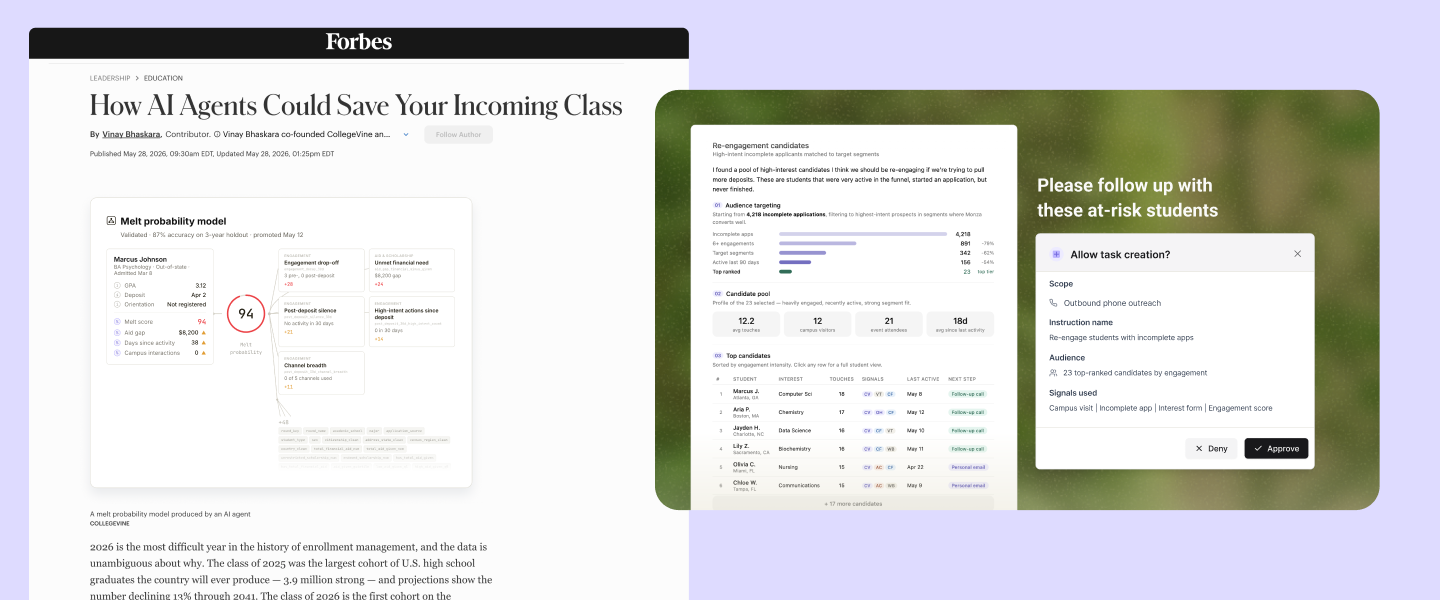
Unlike the chatbots, copilots, and analytics tools that dominate today's AI conversation, AI for operations does not help people work faster. It does the work itself. It runs the verification queue. It builds the schedule. It identifies at-risk students and intervenes before they withdraw.
The operational distinction changes everything.
This proactive approach cannot be solved with a purchase order. The real decision is how AI fits into the institutional operational architecture, and many colleges and universities are about to learn that lesson at great expense.
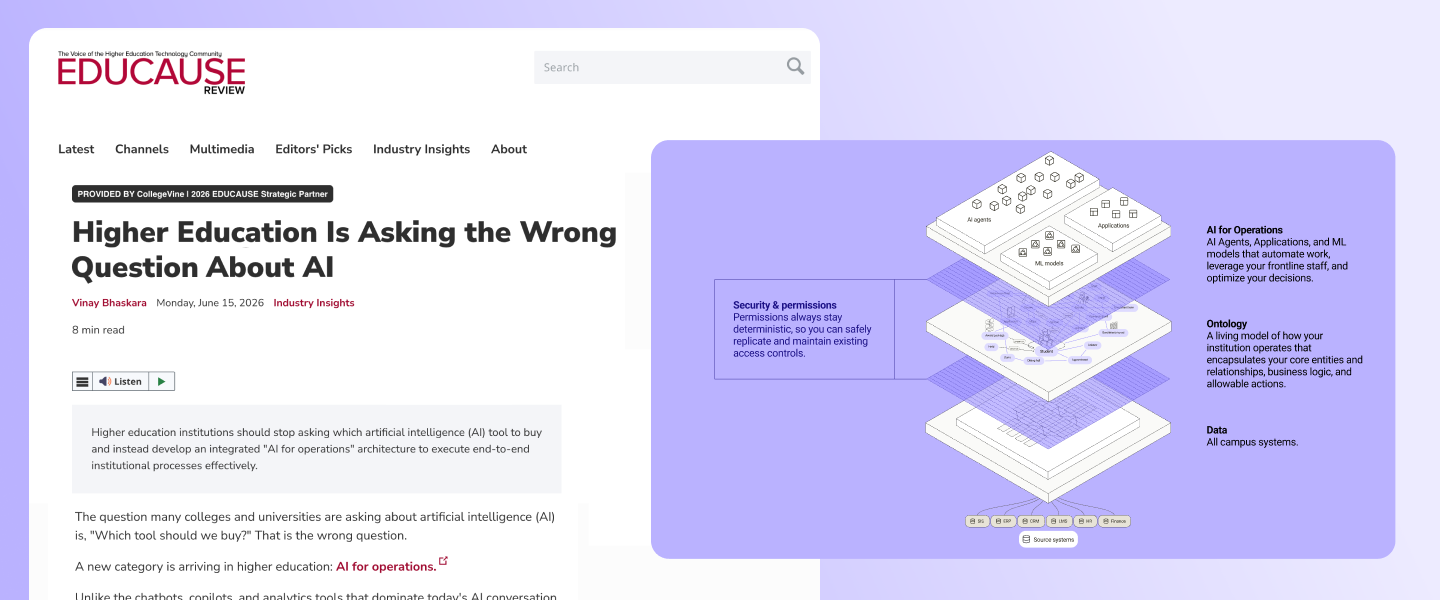
Buying a separate AI capability for each problem feels like progress, but it delivers almost none. No consequential campus process lives in a single silo. Operational AI has four requirements, and all four must hold at once: (1) unified data across disconnected systems, (2) a semantic operational model that captures how the institution runs, (3) multiple instruments built on that shared model, and (4) permissions enforced in the data layer rather than application code.
These constitute a single system, not a menu assembled from four vendors.
If CIOs get it right, the advantages compound. If they get it wrong, they will keep mistaking motion for movement.
The Gap Nobody Admits
When it comes to AI in higher education, two narratives tend to dominate: the breathless one about transformation and all the claims that come with it, and the anxious one about whether any of those claims are real. Both miss what actually changed.
In 2023, researchers introduced three benchmarks—MMMU, GPQA, and SWE-bench—to test the limits of advanced AI; a year later, scores rose by 18.8, 48.9, and 67.3 percentage points on all three, respectively. Adoption followed: 65 percent of organizations now report regularly using generative AI in at least one function, up from roughly a third the year before. The capability and demand are real.
Enterprises are spending enormously, but they don't notice an impact. AI spending across all sectors surged to $13.8 billion in 2024, more than six times that of the prior year, even as roughly four in ten decision-makers questioned whether current solutions fit their needs. Breakthrough capability, record spend, negligible operational change—those are the tells. The money is going to the wrong layer.
The category that matters, AI for operations, has four preconditions, and each maps to a problem colleges and universities already have.
Why Buying Capabilities Fails
A tool bought per problem is smart only inside its own silo: brilliant at the slice it can see, blind to everything it can't. But no process worth automating lives in one silo.
Financial aid verification alone touches the student information system (SIS), the aid system, the document-imaging platform, and the IRS data that FAFSA pulls in. Institutions purchase instruments for each of these touchpoints, but no single system can carry the process end to end. The result is a collection of tools—a chatbot, a predictive model, a workflow platform—but not the ability to complete work.
AI for operations is not a feature to bolt onto that pile. It's a foundation to stand on.
Read the full article EDUCAUSE Review.










.png)
.png)


.png)